
NEWS, EVENTS & BLOG
BLOG
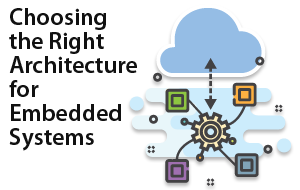
Cloud vs. Edge Computing
 Press Office, VersaLogic Corporation, 04/06/26
Choosing the Right Architecture for Embedded Systems
As connected systems grow more complex, engineers are increasingly forced to make architectural decisions about where data should be processed: in the cloud, at the edge, or somewhere in between. But embedded system designers must evaluate performance, security, and lifecycle tradeoffs. For mission-critical applications, this decision directly impacts latency, reliability, security, and lifecycle cost.
This article outlines the practical differences between cloud and edge computing, and explains why edge-centric architectures are often the better fit for mission-critical embedded systems.
Cloud Computing in Embedded Systems
Cloud computing centralizes data processing and storage in remote data centers. In this model, embedded devices act as data collectors, transmitting information to the cloud where more powerful servers handle analytics, machine learning, and long-term data retention. While this model has supported the growth of many IoT solutions, it also shifts critical system functions away from the device itself. These benefits rely on fast, reliable network connections and tolerance for delays. However, that’s not always realistic which can limit the effectiveness of a cloud-only approach for critical or time-sensitive applications.
Cloud-based systems depend on fast reliable network connections. They can introduce delays that are outside the system’s control. Bandwidth and service costs can grow over time, and sending large volumes of data off-device increases security and compliance challenges. In environments where connectivity is limited or response time matters, a cloud-only approach can constrain performance and reduce system reliability.
Edge Computing for Embedded Applications
Edge computing moves data processing closer to the source, often directly on the embedded system itself. Instead of streaming raw data to the cloud, the system performs real-time processing locally and sends only relevant results upstream. This decentralization of resources enables embedded systems to react instantly to local events, making them highly suitable for environments where immediate response and reliability are critical.
The architecture of edge computing is particularly valuable in harsh or remote settings—such as industrial plants, military deployments, or medical facilities—where network connectivity may be intermittent, slow, or unreliable. By allowing devices to process and respond to data locally, edge computing reduces reliance on external systems and lowers the risk of interruptions.
Many deployments operate over constrained links, particularly in early fielded systems, making cloud-only designs impractical even when stronger infrastructure may be planned for the future. By processing and responding to data locally, edge computing reduces dependence on external systems, supports hybrid cloud approaches, and helps systems continue operating with fewer interruptions.
Key advantages include:
- Fast, predictable responses that support time-sensitive decisions without relying on remote servers.
- Continued operation during network outages, so systems can maintain functionality and safety even when disconnected from the primary network.
- Drastically reduced bandwidth usage, as only essential data or summaries are transmitted, conserving both cost and network resources.
- Improved data protection by keeping sensitive or regulated information on the local device
Edge computing spreads processing across multiple devices, reducing the impact of individual failures and making it easier to expand systems over time. For systems that must operate independently or in challenging environments, edge computing ensures reliable and resilient performance.
Response Time Matters
Latency is often the deciding factor when choosing between cloud and edge architectures. Cloud-based systems can introduce delays caused by network congestion, routing, or service availability. For applications such as vehicle control, robotics, radar processing, or medical monitoring, these unpredictable delays are not acceptable.
Edge systems process data locally, allowing for consistent and predictable response times. This predictability is critical for real-time and safety-critical applications.
Operating When Connectivity Is Limited
Cloud-first designs rely on constant network access. In many real-world embedded environments, connectivity may technically exist but is often slow, constrained by limited bandwidth or high latency. In some cases, such as satellite-based links, delays can approach a full second, making cloud-dependent operation impractical even when a connection is available.
Edge-based systems can:
- Continue operating even when the network is down
- Reduce functionality gradually instead of failing completely
- Share data with the cloud when connections become available
This approach is especially important for defense systems, remote industrial operations, and mobile platforms.
Security and Data Control
Sending raw sensor data to the cloud increases security risk and can make it harder to meet data handling requirements. Edge computing reduces that risk by keeping sensitive data locally and sharing only what is necessary.
Embedded edge platforms can also integrate security features such as TPMs to enable SecureBoot and other data encryption tools locally while also ensuring encrypted data transmission when available. This combination allows data to be securely processed and transmitted in the field, reducing data threat surfaces while retaining physical control.
Lifecycle and Cost Considerations
Cloud infrastructure can appear cost-effective early in a program, but long-term operational costs add up. Bandwidth fees, recurring service charges, and dependency on third-party availability can cause complications over longer lifecycles.
Edge computing shifts more capability into the embedded platform, enabling:
- Predictable lifecycle costs
- Reduced dependence on external services
- Long-term availability aligned with hardware support lifecycles
For regulated industries, this stability is often more valuable than short-term flexibility.
Edge Computing Solutions from VersaLogic
VersaLogic platforms are designed for edge-first architectures, including the Grizzly and Sabertooth AI rugged embedded computers. The Grizzly and Sabertooth AI product lines provide long lifecycle support, ruggedized designs, and board-level integration of high-speed I/O, TPM-based security, and high performance CPUs. The Sabertooth AI offers built-in AI processing as well. These platforms are well suited for edge computing applications that must operate reliably in the field.
The Grizzly is a compact, fanless embedded computer optimized for edge analytics, sensor fusion, and real-time control in space and power-constrained environments. It’s commonly deployed where high performance, industrial temperature operation, and long-term availability are required.
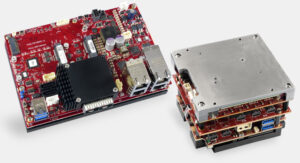
Grizzly (VL-ESU-5070) and Sabertooth AI (VL-ASM51-2AE)
Sabertooth AI is designed for edge computing workloads that require accelerated data processing and AI inferencing at the system level. Sabertooth AI delivers the performance needed for AI-enabled embedded applications across defense, aerospace, medical, security, and energy markets. As connected systems evolve, the question is no longer cloud versus edge. It’s how much autonomy your system needs when the network is slow, unavailable, or untrusted. For most embedded applications, the answer is clear: the edge is where the system earns its keep.
Designing for the Edge Starts with the Right Platform
Cloud services can be useful for aggregating data and gaining system-wide visibility, but they are often a poor fit for supporting embedded systems at the edge. Dependence on constant connectivity, variable response times, and increased exposure of sensitive data can introduce risk in real-world deployments. Processing data locally reduces these dependencies, delivering faster responses, more consistent operation, and greater control over critical information. Platforms such as VersaLogic’s Sabertooth AI and Grizzly are designed for edge-first architectures, supporting reliable operation even when network access is limited, unreliable, or unavailable.
To learn more about building edge computing systems, explore VersaLogic’s rugged embedded computers or contact our team to discuss your application requirements.