
NEWS, EVENTS & BLOG
BLOG
Supply Chain Brief: Memory Market Conditions in 2026
 Press Office, VersaLogic Corporation, 03/02/26
Component Market Update
April 2, 2026
Global DRAM supply remains extremely tight, and prices are still climbing. Recent industry reports confirm that memory makers are prioritizing high-end (AI/server) products, leaving legacy DDR4/DDR3 supply scarce. Lead times are very long, and customers should plan accordingly.
DRAM pricing has remained on an upward trajectory and availability is still constrained, reinforcing the need to align near-term demand with timely order placements.
- Pricing Trends
Contract DRAM prices have continued to firm. For example, TrendForce notes that contract prices “solidified gains” (with DDR5 leading) in early March[1]. Reuters reports TrendForce now forecasts a 90–95% quarter-on-quarter jump in first-quarter 2026 DRAM prices, driven by the AI boom[2]. In the spot market, recent data show DDR4 prices basically flat (a slight 0.3% dip) as Samsung temporarily froze DDR4 quotes[3], but overall prices remain at record highs across DDR3/DDR4/DDR5. - Supply & Lead Times
All DRAM categories are under strict allocation. For legacy memory, reports indicate that heavy enterprise buying of DDR4 has simultaneously tightened DDR3 supply, causing high-density DDR3 products to become scarce[4]. Even though some buyers are chasing DDR3 to save cost, factory capacity is limited and order fill rates are low. Lead times remain very long (often 30–40+ weeks for standard DRAM modules[5]), and additional orders generally require firm, multi-quarter contracts. - AI/Server Demand
Demand from AI and cloud servers continues to absorb most new output. Industry analysts note that major cloud providers (Google, Microsoft, Amazon, Meta, etc.) have placed open-ended DRAM orders, essentially agreeing to take “as much supply as available”[6]. Memory suppliers are therefore concentrating wafer starts on server DDR and high-bandwidth (HBM) products[1][6]. This leaves conventional PC/embedded DRAM in tighter supply, indirectly driving up costs for DDR4/DDR3 further. - Near-Term Outlook
Little relief is expected in 2026. New fab capacity is coming—but not soon. Memory experts stress that announced expansions (Samsung, SK Hynix, Micron, Kioxia, etc.) require 12–18 months of ramp-up. As a result, “new fabs…will not reach meaningful production volume until late 2026 or 2027”[7]. In short, structural supply tightness is likely to persist throughout 2026, even if consumer demand is softer[1][8]. (Many analysts say today’s high prices are the “new normal” given these constraints.) - Customer Actions
Customers should expect continued high costs and tight allocations. Industry guidance is to forecast needs well in advance and secure supply now. Analysts note that first-half-2026 DRAM purchases carry 30–60% cost premiums versus 2024 levels[9], and that long lead times mean early orders effectively set deployment schedules. In practice, companies without multi-quarter contracts may face stockouts or will have to buy at extremely high spot prices.
DDR3, DDR4, DDR5 status in March 2026
Availability is very limited across all segments; prices are continuing to rise; and lead times remain extended (often >30 weeks).
| Memory Type | Availability | Price Trend | Lead Time |
|---|---|---|---|
| DDR3 | Constrained (shrinking) | Rising sharply (catch-up) | Very long |
| DDR4 | Very tight (phasing out) | Surging higher | Very long |
| DDR5 | Severely constrained | Highest & rising rapidly | Very long |
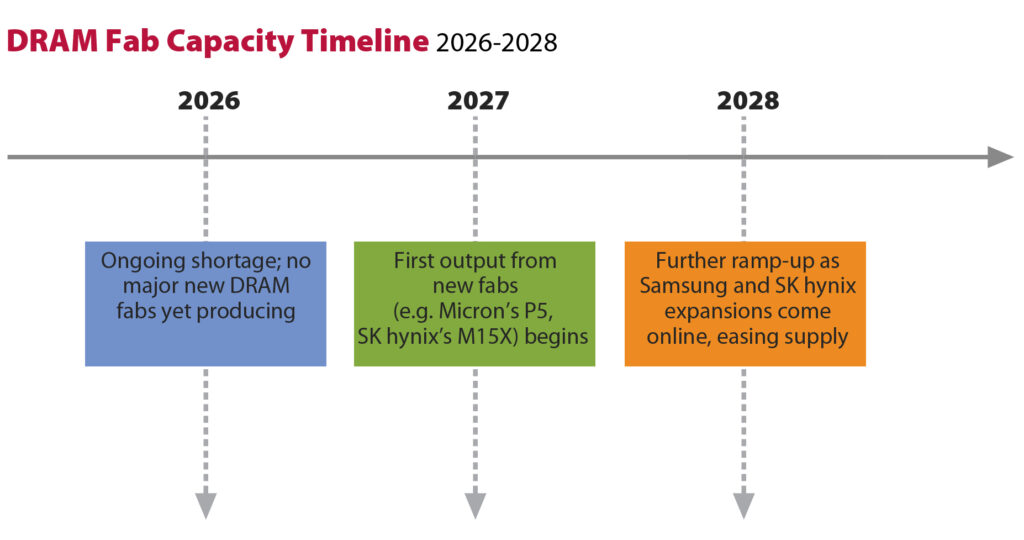
For example, industry analysts note that new DRAM fabrication fabs under construction will not meaningfully add output until 2027 or later[8].
The timeline below illustrates when new capacity is expected to come online:
Potential Correction Scenarios
While the current trend is upward, the following scenarios could theoretically trigger a market correction (with rough likelihoods):
- AI Spending Pullback (Medium ~30%)
If hyperscalers unexpectedly cut back on new data-center or AI projects, DRAM demand would drop quickly. (Currently, no slowdown is visible, but a sharp strategic shift could ease the crunch.) - Technology/Macro Downturn (Low ~15%)
A broad recession (slashing PC, server, or smartphone sales) could reduce DRAM demand across industries. Such a scenario would ease prices, but global indicators make this unlikely in 2026. - Supplier Oversupply (Low ~10%)
Only a sudden, major jump in commodity DRAM output (e.g. unscheduled older-node fab ramps) could flood the market. Given that new fabs aren’t operational before 2027[8], this remains a low-probability event. - Geopolitical/Policy Shift (Low ~5%)
Large-scale policy changes (e.g. massive domestic DRAM subsidies or trade treaties) could alter supply dynamics. No such developments are currently anticipated in 2026.
In summary, absent one of these shocks, DRAM market tightness and high prices are expected to persist through 2026.
Sources: Market research from TrendForce and industry analysts[1][2][7][6], and recent tech news reports on DRAM pricing and demand.
For more information please contact VersaLogic at:
- Call: 503-747-2261 Toll-Free: 800-824-3163 Fax: 971-224-4708
Monday – Friday 8 a.m. – 5 p.m. Pacific Time - Email: Sales@VersaLogic.com or Info@VersaLogic.com
- Contact VersaLogic
[1] DRAM Market Bulletin – Mar. 4, 2026 | TrendForce https://www.trendforce.com/research/download/RP260304DF
[2] Trendforce sees chip prices surging 90-95% in Q1 from previous quarter | Reuters https://www.reuters.com/technology/trendforce-sees-chip-prices-surging-90-95-q1-previous-quarter-2026-02-02/
[3] (Insights) Memory Spot Price Update: DRAM Spot Momentum Constrained as March Contracts Hold, DDR4 Weakest https://www.trendforce.com/news/2026/03/25/insights-memory-spot-price-update-dram-spot-momentum-constrained-as-march-contracts-hold-ddr4-weakest/
[4] (News) DDR4 Reportedly Leads Legacy Memory Rally with Q1 Prices Up to 50%; DDR3 in Tight Supply https://www.trendforce.com/news/2026/01/19/news-ddr4-reportedly-leads-legacy-memory-rally-with-q1-prices-up-to-50-ddr3-in-tight-supply/
[5] [6] [7] [8] [9] Memory & Flash Crisis Update (March 2026) | NAND Research https://nand-research.com/memory-flash-crisisc-update-march-2026/
Component Market Update
March 3, 2026
Since our last update, market conditions show that the DRAM market is not easing. This makes it increasingly important for customers to align near-term needs with timely order placement to help ensure supply.
- Pricing Continues to Move Up
Memory pricing for DDR4 and DDR5 continues to trend upward, with suppliers issuing ongoing increases. Quotes are changing quickly, and pricing visibility remains limited as availability stays tight. - Supply Remains Constrained
DDR4 and DDR5 components continue to be tightly controlled by suppliers, with long lead times and limited flexibility. Some customers are turning back to DDR3 as a lower-cost option, but factory capacity for DDR3 is limited and order commitments are becoming increasingly difficult to secure. - AI Demand Is Still Driving the Market
Demand tied to AI infrastructure continues to absorb a large share of global memory production. As a result, suppliers remain focused on serving those segments first, leaving less supply available for traditional embedded and industrial applications. - Relief Is Not Around the Corner
While memory manufacturers are investing in new capacity, most of it will not come online until 2027 or later. This suggests that current market pressures are likely to remain in place through 2026. - What This Means for Customers
We expect continued pricing pressure and limited ability to support unplanned demand. Providing forecast visibility and placing orders in advance remains the best way to help secure supply.
For more information please contact VersaLogic at:
- Call: 503-747-2261 Toll-Free: 800-824-3163 Fax: 971-224-4708
Monday – Friday 8 a.m. – 5 p.m. Pacific Time - Email: Sales@VersaLogic.com or Info@VersaLogic.com
- Contact VersaLogic
Component Market Update
February 3, 2026
Since issuing our prior briefing on the DDR4 and DDR5 memory environment, new industry announcements and supplier signals have emerged that provide additional clarity on timing, capacity expansion, and the ongoing impact of AI-driven demand. The most relevant updates are outlined below.
- Supply Remains Structurally Constrained: Recent industry updates continue to indicate that DDR4 and DDR5 supply tightness will persist into 2026–2027, with AI and server demand absorbing the majority of available and incremental memory capacity.
- Pricing Pressure Continues: Near-term pricing remains volatile and biased upward, with suppliers maintaining allocation controls and prioritizing higher-margin AI and server-class products.
- Micron Expansion Activity (Long-Term Impact): Micron announced multiple major investments across Idaho, New York, Virginia, and Taiwan totaling well over $150B; however, meaningful incremental DRAM output from these efforts is not expected until 2027 or later, reinforcing the lack of near-term supply relief.
- Asian Supplier Signals: Taiwanese DRAM manufacturers, including Nanya, continue to signal tight supply conditions and strong booking behavior through at least mid-2027.
- Industry Outlook: Public market commentary published this week reinforces that current shortages are structural rather than cyclical, with new capacity additions lagging demand growth driven by AI workloads.
- Our Actions: VersaLogic is actively qualifying additional memory sources to mitigate supply risk and manage cost, while maintaining allocation controls aligned to confirmed customer purchase orders.
For more information please contact VersaLogic at:
- Call: 503-747-2261 Toll-Free: 800-824-3163 Fax: 971-224-4708
Monday – Friday 8 a.m. – 5 p.m. Pacific Time - Email: Sales@VersaLogic.com or Info@VersaLogic.com
- Contact VersaLogic
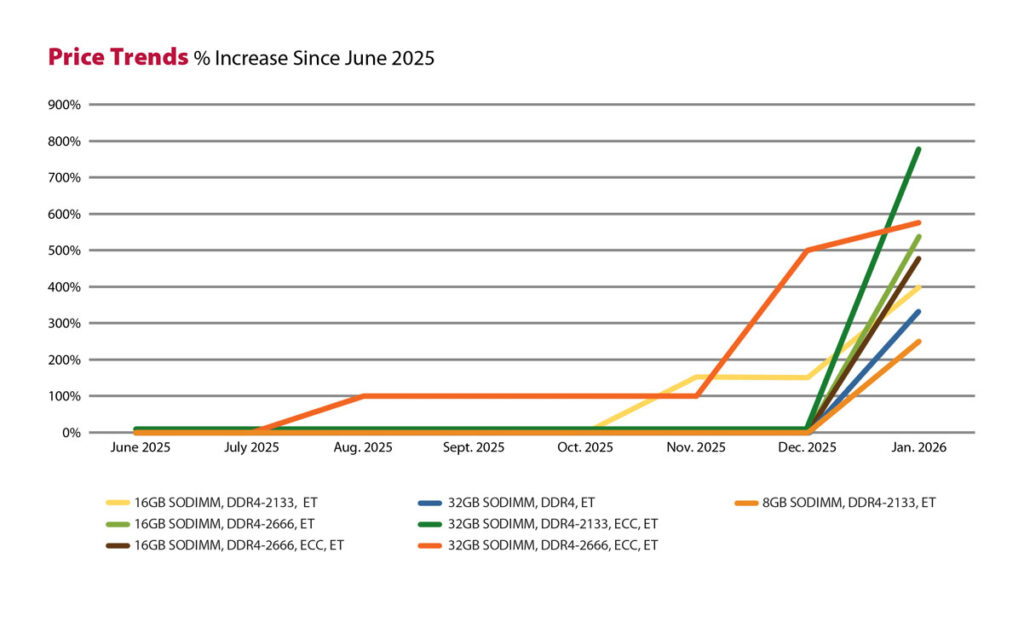
January 20, 2026
The global semiconductor supply chain remains under significant strain in early 2026, with DDR4 and DDR5 memory markets facing sustained shortages and extreme volatility. What initially appeared to be short-term disruption has become a longer-term structural imbalance between supply and demand.
To read the full supply chain brief, download below:
DOWNLOAD SUPPLY CHAIN BRIEF
Pricing Volatility and Allocation
Memory pricing has increased sharply over the past several months:
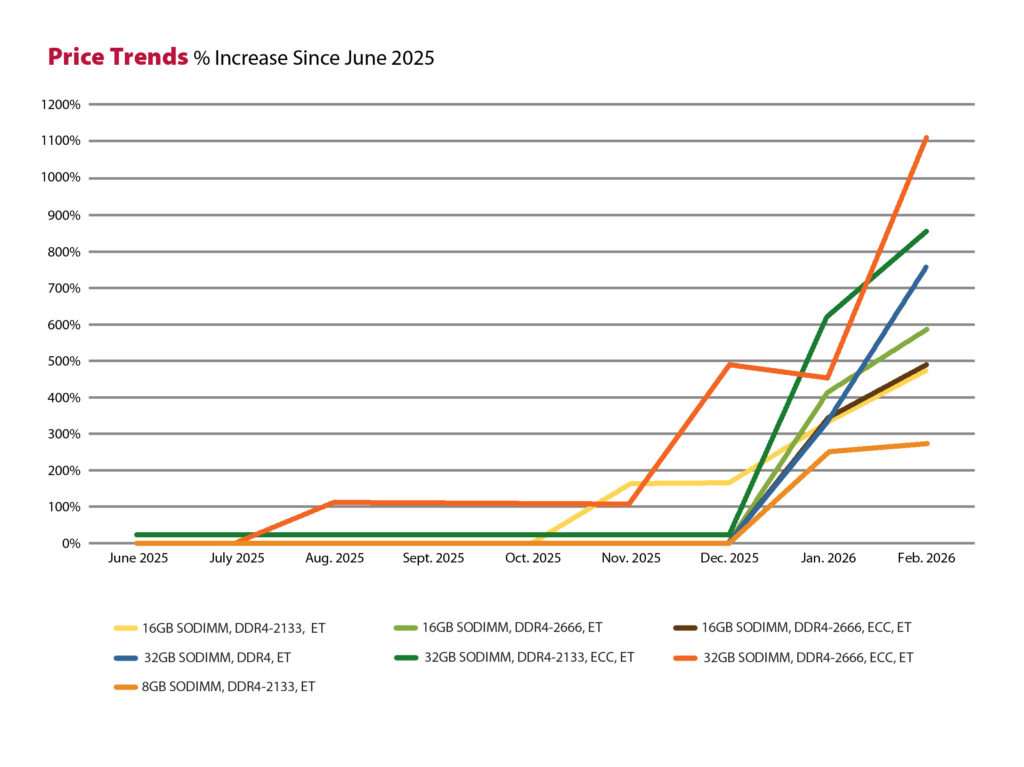
- DDR4 and DDR5 prices have more than doubled in many cases.
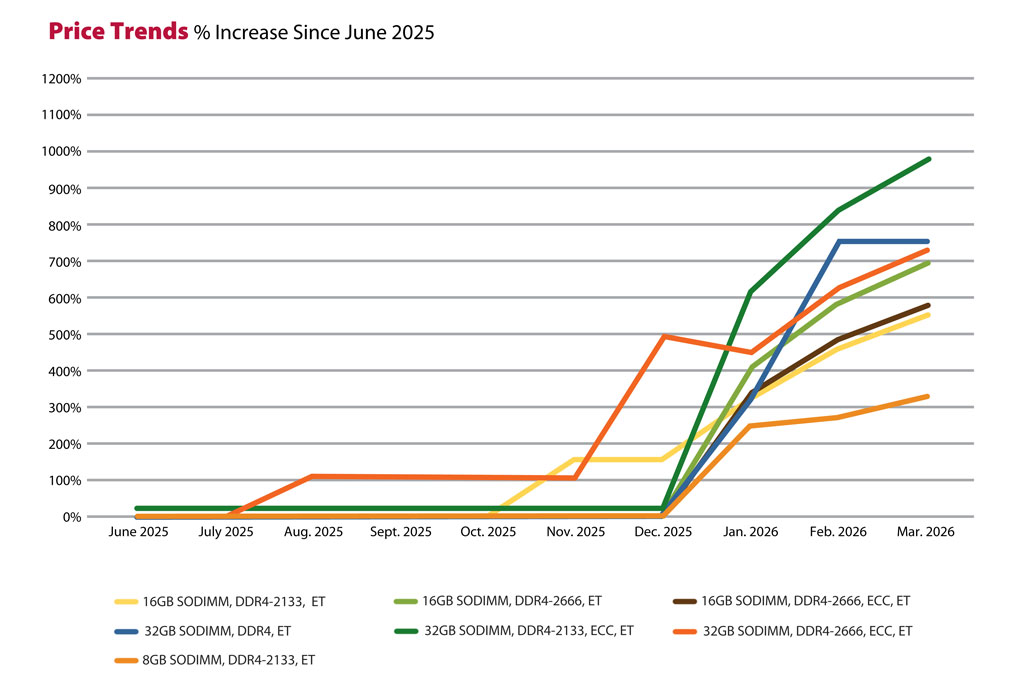
- VersaLogic has seen individual memory components increase up to 700% compared to historical pricing.
- Supplier quotes are often short-lived and may change prior to shipment.
In parallel, memory components are largely under allocation, limiting flexibility for incremental or unplanned demand.
Lead Times Remain Extended
Availability continues to be constrained:
- Typical lead times for memory components are now 32 to 40+ weeks.
- Even modest increases in demand may not be supported without significant advance notice.
- These extended lead times have effectively become the new normal for memory sourcing.
Root Cause
Two primary factors are contributing to the tight market:
- AI and data center demand is consuming a growing share of global memory capacity.
- Memory manufacturers are prioritizing higher-margin products, such as HBM and server-grade DDR5, reducing output for standard DDR4 and embedded-focused parts.
New memory fabrication capacity is not expected to come online until late 2026, meaning current conditions may persist into 2027.
VersaLogic Response and Customer Guidance
To manage risk and ensure delivery stability, VersaLogic now procures memory only against confirmed customer purchase orders. Products that include memory are placed on allocation to support planned builds.
Customers are encouraged to place orders as early as possible and work closely with their VersaLogic sales representative to align schedules and expectations.
Proactive planning remains the most effective way to navigate today’s memory supply environment. We value your continued partnership as we work through these unprecedented market conditions together.
For more information, please contact VersaLogic.